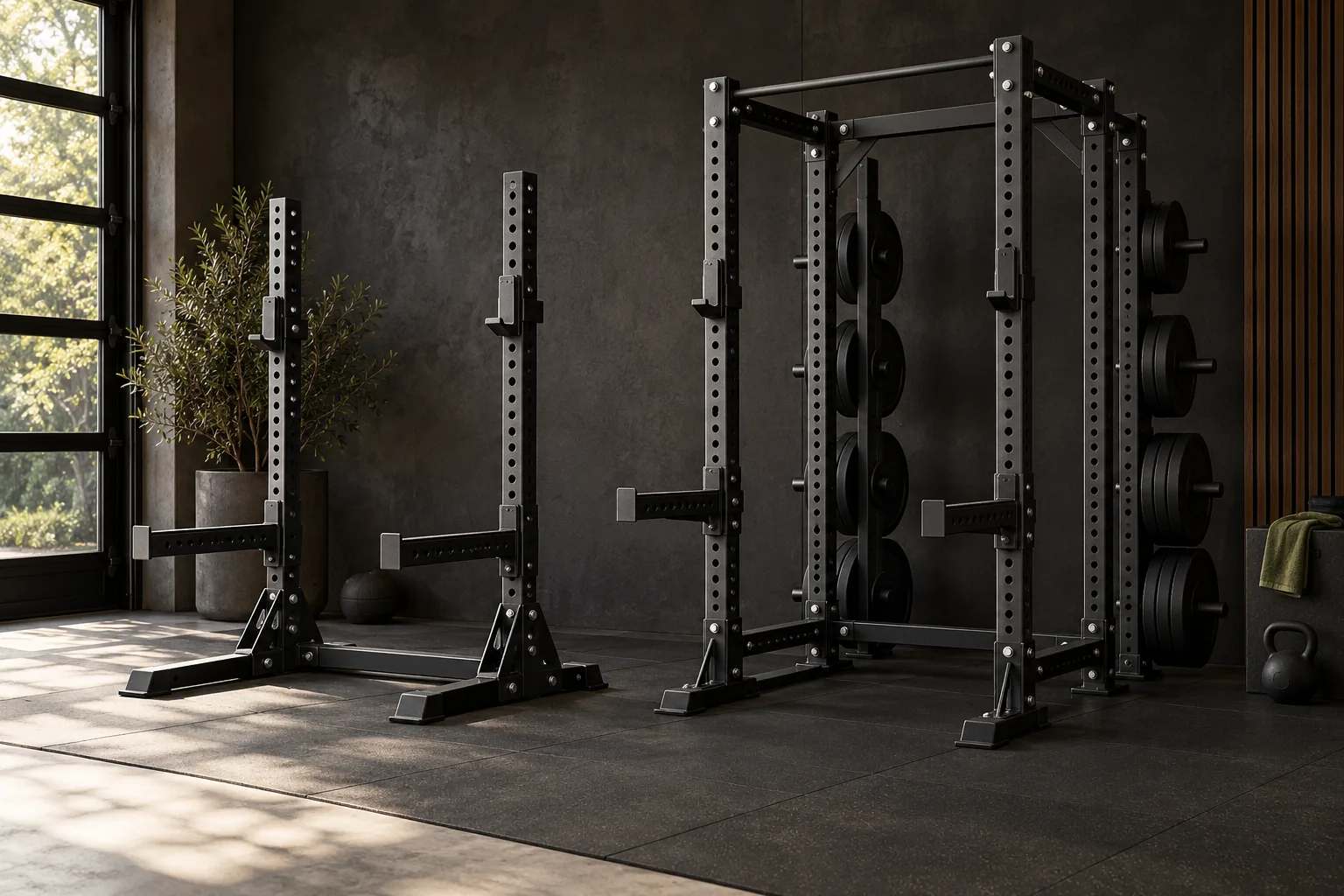
Choose between stands and a half rack by comparing the complete equipment, permitted use and working layout. “Half rack” does not guarantee stability, and movable stands are not automatically suitable for a lift just because their bases fit.
Start with named dimensions
Rogue lists its SML-1 stand base at 49 in wide by 48 in deep and total height at 72.25 in, without a pull-up bar. The HR-2 half rack is listed at 48 in wide by 49 in long, with overall heights of 92.25 or 110.25 in depending on the option. These examples show that a stand can have almost the same base area as a half rack.
Use the axes on the specific product drawing. Include feet, rear storage, plate overhang, band pegs, attachments and the bar itself; a crossmember length is not the full footprint. The examples are specification comparisons, not hands-on tests.
Compare the safety system as a configuration
- Does the manufacturer permit the intended lift and attachment combination?
- Are the safeties compatible with the exact upright series, hole pattern and depth?
- Does their supported catch area cover the intended movement at the required setup?
- What anchoring, support or additional components does that configuration require?
Do not choose a safety height from a universal distance above or below the bottom of a squat or the chest. Follow the equipment guidance and obtain competent setup help when unsure. A load rating for a rack is not automatically the rating or allowed use of every attached arm.
No universal ballast prescription
The HR-2 page says that model does not need floor bolting. In contrast, Rogue’s Bolt-Together R-3 explicitly requires floor bolting before use. One product’s instructions cannot be transferred to another, and a generally heavier frame cannot establish safe behavior during an outside catch.
Do not replace a required anchor with an arbitrary 180–360 lb of stored plates. Use only the specified storage and stabilization arrangements. Independent stands also need their approved spacing and compatible bar/support areas; moving them closer is not a general solution for a short shaft.
Draw the outermost working extent
A base and a spotter arm can overlap in plan. Adding their full depths blindly can overcount, while measuring only the base can miss an arm projecting farther. Measure from one reference line to the furthest front and rear points of the assembled configuration, then add the required working and access areas.
Use the full bar length plus access at both ends for width. In a hypothetical 96 in width, an 86.75 in Ohio Bar leaves 9.25 in in total. Neither the stand’s width nor diagonal placement alone establishes usable loading or exercise clearance.
Moving and storing equipment
Check whether the exact model is designed to move and how it must be unloaded or disassembled first. Do not add wheels, shims or improvised storage ballast to solve a space problem. Verify the supporting surface, delivery path and every working/storage configuration before buying.
Continue planning
- Compare rack interior and full footprints
- Compare exact bar lengths, rack compatibility and both loading ends
- Organize measured equipment outlines in the room planner
Check height and stored space before choosing a rack
- Compare 82 vs 90 inch rack height and overhead clearance
For a fixed rack, check the rack top, pull-up bar and overhead movement separately. A footprint comparison does not answer the ceiling question.
- Plan folding rack stored depth, swing space and walkways
Considering a folding alternative? Measure its stored projection and folding path as well as the space it occupies during training.
The guides explain planning checks. Use the exact model’s instructions and your measured room; generic examples do not establish installation safety or exercise clearance.
FAQ
Are half racks automatically safer than stands?
No. Compare the actual permitted configuration, safety system, anchoring and supporting surface. Equipment category or mass alone cannot rank safety.
Can stored plates replace floor bolts?
Only follow the manufacturer’s specified arrangement. An arbitrary plate weight does not replace a required anchor.
Should I add base depth and full arm length?
Measure their combined outermost envelope from a common reference; overlapping parts should not be counted twice. Add working access separately.