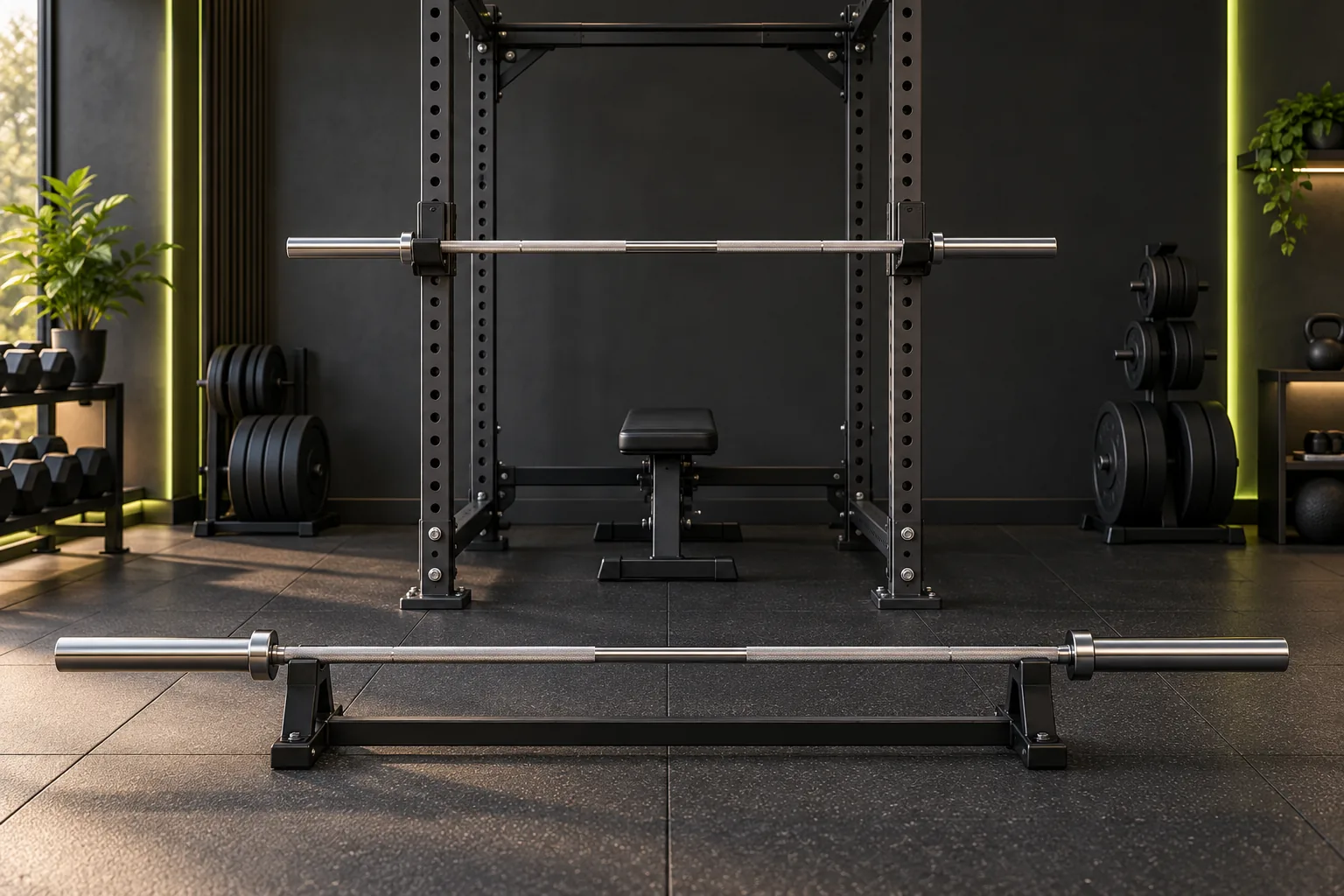
AI-generated cover illustration: a short bar across a rack and a longer bar on a separate cradle. This is a conceptual example, not a measured layout or a verified installation.
A shorter bar can recover useful space in a narrow home gym, but “6 ft” does not tell you whether it will fit your rack or hold your plates. Compare the actual end-to-end length, the shaft space between the sleeves and the loadable sleeve length separately. Then allow room to load, handle collars and move around both ends.
The quick decision
- Keep a full-length bar when its real length, your plate-changing routine and your training movements work in the room.
- Consider a rackable short bar when the rack fits but the sleeve ends crowd walls or storage. Check the exact bar-and-rack combination before buying.
- Do not buy a short bar on length alone. Some compact bars shorten the shaft between the sleeves; others preserve that shaft and shorten the sleeves. Those choices have different consequences.
Measure three bar dimensions, not one
Overall length is the end-to-end obstruction in your room. Use the specification for the exact model, not its rounded “7 ft” or “6 ft” description. Include any collar hardware that extends beyond the stated envelope.
Distance between sleeves helps determine rack compatibility. Both J-cups must support the intended shaft area, without a sleeve shoulder resting on a cup or an awkwardly precise sideways position being required. Measure your actual J-cup arrangement and ask the manufacturer about the exact combination if compatibility is unclear. There is no universal “add two inches” rule that certifies every rack.
Loadable sleeve length is the room for plates and retaining collars on each side. Measure the thickness of the plates you intend to use, not just their total weight. A stack of thick bumper plates can exhaust a short sleeve before your planned load is reached.
What real short-bar specifications show
These manufacturer examples illustrate the trade-off; they are not hands-on tests or a recommendation to buy a particular brand. Specifications were checked on October 24, 2026. Metric values are rounded conversions.
| Model | Overall length | Between sleeves | Loadable sleeve, each side |
|---|---|---|---|
| Rogue Ohio Bar, Black Oxide | 86.75 in / 220 cm | 51⅞ in / 132 cm | 16.40 in / 41.7 cm |
| Rogue C-70S | 72 in / 183 cm | 52 in / 132 cm | 8.875 in / 22.5 cm |
| Rogue C-70 | 69 in / 175 cm | 43 in / 109 cm | 12 in / 30.5 cm |
Rogue describes the C-70S as rackable and says the C-70 does not fit most conventional racks or stands. The slightly longer short bar preserves more shaft space by giving up sleeve space. That is why “the shortest bar” and “the right bar for my rack” are different decisions. Confirm current specifications and compatibility for your exact equipment.
Calculate the space left at each end
For a bar centered between two parallel obstructions, use space at each end = (clear room width − actual bar length) ÷ 2. Measure the usable width at bar height: shelving, radiators, handles and stored equipment can make it smaller than the floor plan suggests.
Hypothetical 8 ft room: 96 in (244 cm) of clear width minus an 86.75 in bar leaves 9.25 in total, or about 4.6 in (12 cm) per end. A 72 in bar leaves 12 in (30 cm) per end. The shorter bar improves the arithmetic, but those figures alone do not demonstrate enough room for your hands, plates or movements.
Hypothetical 9 ft room: 108 in (274 cm) of clear width leaves about 10.6 in (27 cm) per end around the longer example, versus 18 in (46 cm) around the shorter one. Compare both cases with the way you actually change plates. Moving the rack sideways gives one end more room while taking it away from the other.
These are planning examples, not minimum safety clearances. No single side gap guarantees safe use for every lift, plate diameter, person or room. Follow equipment instructions and keep doors, access routes and exercise movement clear.
Check loading and training space before ordering
- Mark the full bar length. Use removable floor tape to show both ends and the rack position. Account for the bar's position during use, not just storage.
- Check both loading sides. A plate must travel onto each sleeve, with room for your hands and collar. A comfortable loading area on one end does not solve a blocked opposite end.
- Add your plate stack. Sum plate thickness and the space required by the chosen collar on each sleeve. Do not use an assumed number of plates or leave collars off to make a stack fit.
- Check the exercise envelope. Bench adjustment, squat walkout, safeties, spotting and overhead work require separate checks. A smaller bar does not shorten a bench or provide overhead clearance.
- Check storage and delivery access. Trace the route through doors and corners and the path into your chosen holder. A bar's half-length is only a geometric radius about its center; it is not a reliable hallway-turning test.
Never force an unsuitable bar onto the sleeves or improvise closer support positions on a fixed rack. If you use independent stands, follow their instructions for spacing, stability and compatible safety equipment.
Choose the complete setup
Write down the exact bar, rack, plates and collars as one proposed setup. Prefer a combination whose published dimensions and compatibility you can verify. When a measurement is missing, ask for it before ordering rather than treating it as a fit.
Use HomeGymPlanner to organize the room and equipment choices, then separately check the loading and exercise space described here. Our 10×10 home-gym layout guide explains equipment lanes; the low-ceiling rack guide covers height checks. For surface protection and noise considerations, read the flooring guide. If you are assembling a first setup, use the starter setup guide as a planning framework and verify current costs separately.
Primary sources
- Rogue Ohio Bar — Black Oxide: length, shaft spacing and loadable sleeve specifications.
- Rogue C-70S: rackable short-bar dimensions.
- Rogue C-70: compact-bar dimensions and stated rack limitation.
FAQ
Will any 6 ft barbell fit my power rack?
No. Check the distance between sleeves and the manufacturer's compatibility advice for your actual J-cups and rack. Short bars can preserve a rackable shaft or shorten it.
How much narrower is the example 72 in bar than the 86.75 in bar?
It is 14.75 in (about 37.5 cm) shorter overall. Centered in the same clear width, that recovers about 7.4 in (18.7 cm) at each end. It does not establish a safe loading or exercise clearance.
Is a 7 ft barbell exactly84 in long?
Not necessarily. The name is approximate; the cited Ohio Bar is 86.75 in long. Plan with the exact model's published end-to-end measurement.
Can a short bar hold my normal plate stack?
Check actual loadable sleeve length against the thickness of your plates plus the collar space on each side. Do not infer capacity from plate weight alone or omit collars to gain space.
Does a rack footprint include space to load a bar?
Usually it describes the equipment footprint. Separately check the full bar, both loading ends, movement, access and equipment-specific instructions. A positive footprint fit is not a clearance certification.