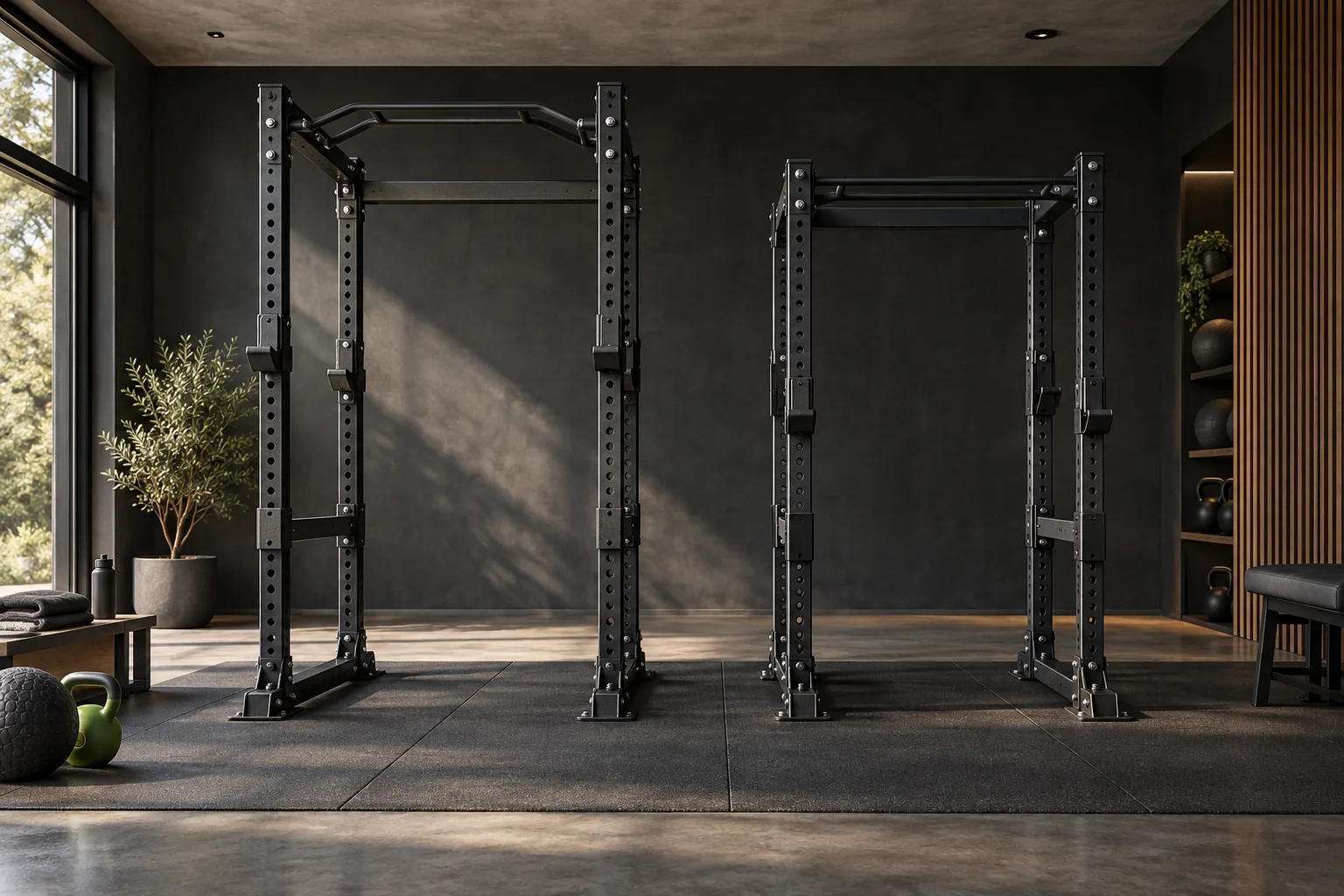
Under a truly clear 96 in ceiling, a complete 82 in frame leaves 14 in and a complete 90 in frame leaves 6 in. Those are frame-to-ceiling remainders. They do not tell you the pull-up-bar height, room needed to assemble the rack or space occupied by a person or loaded bar.
Use overall height rather than a model label
Check the tallest part of the selected configuration, including feet, crossmembers, pulleys and attachments. Rogue’s SML-1 is sold as a “70” stand but lists 72.25 in total height and no pull-up bar. Its HR-2 offers nominal 90 or 108 in front uprights but lists overall heights of 92.25 or 110.25 in. Product names cannot replace the complete specification.
| Finished clear ceiling | 82 in frame remainder | 90 in frame remainder |
|---|---|---|
| 96 in | 14 in | 6 in |
| 90 in | 8 in | 0 in |
A zero remainder leaves no spare geometric height and cannot establish installation feasibility. An 82 in rack is not automatically the best choice: user position, allowed configuration and assembly instructions still decide whether it is suitable.
Pull-up clearance uses the actual bar
Do not assume the bar center sits two inches below the frame top. Record its actual height, the user’s floor-to-grip length and the full movement above it. Raising and lowering the bar exchange floor space for overhead space. Bending knees affects the body position; it does not turn an unverified overhead gap into a pass.
Only invert a bar or change crossmember positions when the exact manufacturer permits it. The same change can affect structure, accessories or available grip positions. No generic 8, 12 or 18 in overhead allowance certifies pull-ups, kipping or muscle-ups.
Pressing needs the plate path, not a height-based shortcut
Establish the highest bar-center position throughout the intended movement without attempting a lift near an obstruction. Add the actual plate radius to find the top of a vertical plate, then account for the complete movement and required allowances. A 45 lb label does not uniquely determine diameter, and your standing height plus a fixed number does not determine lockout height.
Hypothetical geometry: bar center at 86 in plus a 9 in radius reaches 95 in before any additional allowance. Smaller diameter plates change that radius; they do not prove the whole movement is suitable. Do not recommend a push press or a modified exercise as a way around an unknown ceiling limit.
Measure from one reference surface
Use the finished supporting floor. If the 96 in measurement was taken before adding a planned 0.75 in floor, the remaining height is 95.25 in. If measured from the new surface, do not subtract that thickness again. Also check the assembly path and the lowest light, beam or garage-door mechanism throughout use.
Continue planning
- Check independent pull-up floor and overhead margins
- Check complete short-rack dimensions
- Map height across a sloped ceiling
FAQ
Does a 90 in frame fit below a 96 in ceiling?
It leaves 6 in geometrically if 90 in is the complete assembled height. Assembly, attachments, actual bar position and exercise clearance remain separate checks.
Is an 82 in rack automatically suitable for pull-ups?
No. Use its actual bar height and the user’s complete floor and overhead movement, plus the permitted configuration.
Can I lower or invert a crossmember?
Only if the exact manufacturer permits that configuration. Do not modify structural assembly to satisfy a generic ceiling calculation.