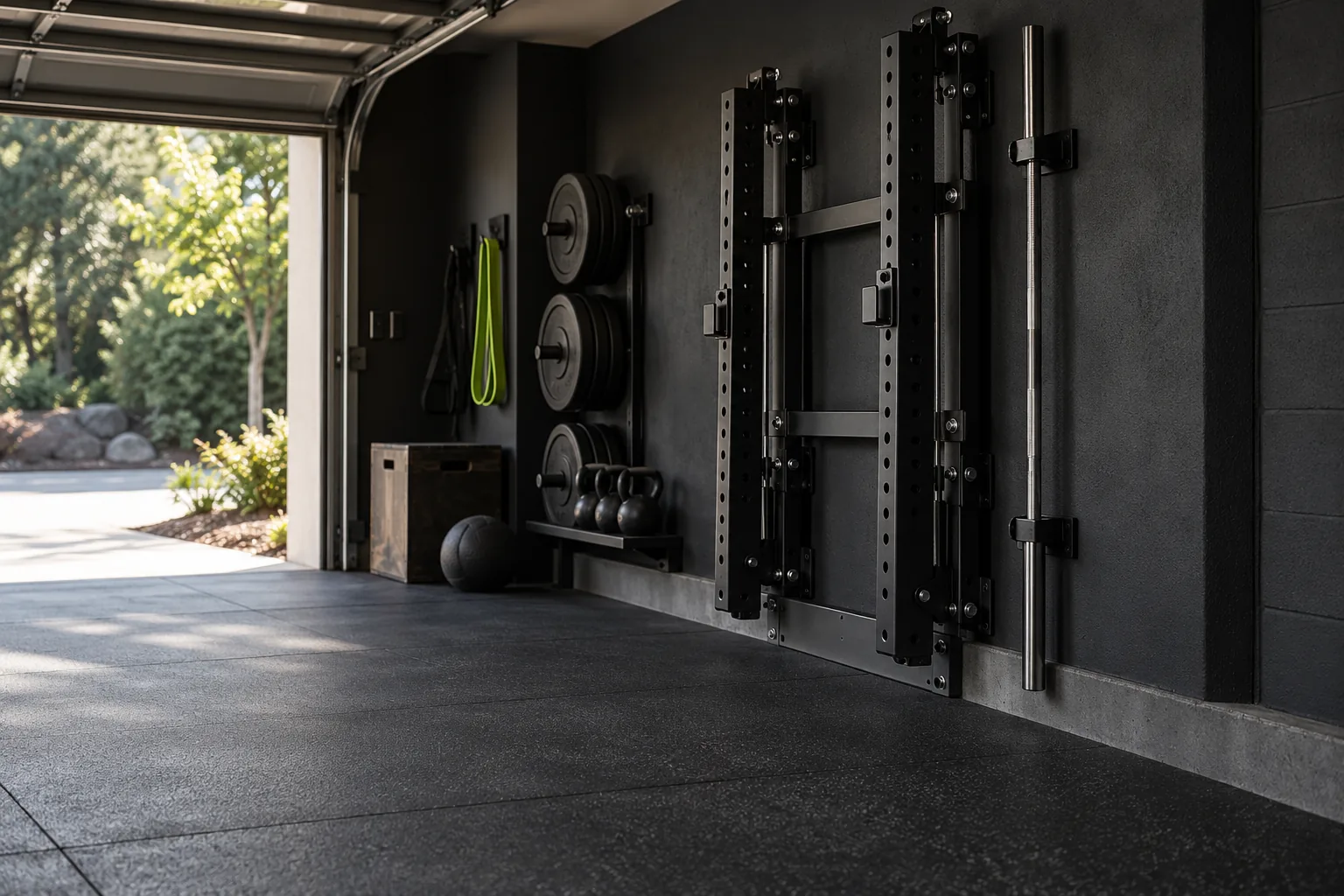
A fold-back rack can recover floor space between sessions. Its folded thickness does not describe the room needed to unfold it, load a bar or exercise. Record three configurations: open, stored and moving between them.
Inside depth and wall projection are different
Rogue’s RML-3W illustrates the distinction. The manufacturer lists inside depths of 21.5 and 41.5 in, with wall projections of 24.75 and 43.75 in respectively. Its overall on-wall width is 56.1875 in. Resolve the installed stringer, trim and attachment configuration against the current drawing instead of treating an arm label as the whole footprint.
Rogue describes the rack as taking less than 5 in from the wall when stowed. That is a claim for its intended folded configuration, not a promise for every installed rack with accessories left attached. Measure the furthest actual projection, including pins, cups, pegs and backing.
The folding path can decide whether it works
The RML-3W page says its 21.5 in version can fold both sides inward or outward. With the 41.5 in version, both sides fold outward or one folds inward and the other outward. Those different arrangements can meet adjacent shelves or door openings differently.
Do not approximate every swept path as arm depth plus a few inches. Use the complete manufacturer geometry and operating sequence, including any required pull-up-bar removal, pin access and user position. Trace the entire path while equipment is unloaded and handled as instructed. Check floor contact and overhead obstructions through the transition, not only at the endpoints.
Calculate the space that remains
Remaining clear strip = measured room width − actual stored projection − opposite-side obstructions. Hypothetical example: 60 − 7 − 12 = 41 in (104.14 cm). If the same installed rack projects 11 in with permitted accessories, the strip becomes 37 in (93.98 cm).
These numbers describe empty space only. Neither is an approved walkway, accessible route or exercise zone. Check the real route, doors, people carrying equipment and applicable building/access requirements. A chosen route width must not be presented as a universal legal or safety minimum.
Store removed equipment too
Mark where the bench, bar, plates and removed attachments go when the rack is folded. They cannot consume the route that folding was meant to recover. Store a bench upright or hang accessories only when their exact instructions permit that position and support.
Mounting and floor levels are separate decisions
Do not notch backing, relocate hinges, improvise spacers or shim rack feet just to improve the profile. Follow the approved mounting and leveling arrangement. Include planned floor thickness once: measure from the finished supporting surface, or deduct a future floor build-up from the current measurement. Surface protection does not certify the building load or noise performance.
Continue planning
- Check wall-mount requirements before ordering
- Plan a shallow storage opening
- Separate flooring protection, structural capacity and neighbor noise
FAQ
How thin is a stored folding rack?
Use the exact installed configuration. Rogue describes the RML-3W as less than 5 in when stowed; backing and retained attachments must be resolved separately.
Does a deeper folding rack have the same folding path?
No assumption is safe. The cited RML-3W depth versions have different allowed inward/outward arrangements. Use the selected version’s complete geometry.
Does remaining width establish a safe walkway?
No. It is an arithmetic remainder; check the actual access route and applicable requirements separately.