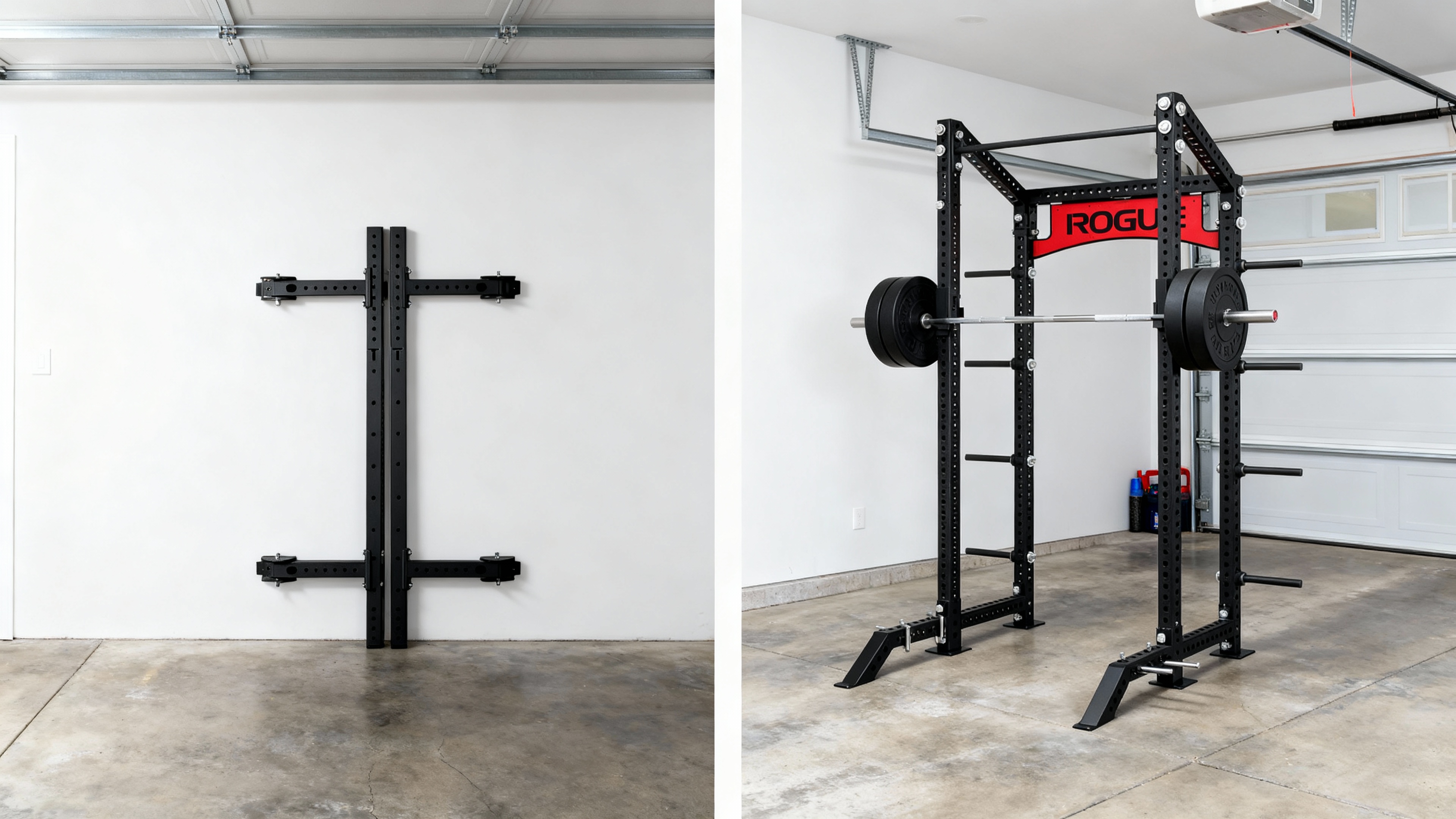
Compare a folding wall rack with a half rack in the configuration you will actually use. Folding can recover floor depth between sessions; a fixed rack can avoid that transition. Neither category alone establishes installation suitability, stability or working clearance.
Named specifications, not universal depth ranges
| Example | Published outline | Storage/changeover |
|---|---|---|
| Rogue RML-3W | 24.75 or 43.75 in from wall, 56.1875 in on-wall width; 90.375 in height | Manufacturer describes less than 5 in stowed; verify installed accessories and full fold path |
| Rogue HR-2 | 48 × 49 in base; 92.25 or 110.25 in overall height | Fixed frame; storage attachments and plates extend the actual envelope |
The folding rack’s 21.5 or 41.5 in interior labels are different from wall projection. Its two depth versions also have different inward/outward folding arrangements. The half rack’s base does not include an unlimited amount of plate storage or the user’s movement.
Compare a complete session
- Before training: where do the car, bench, bar and removed attachments go?
- During setup: can you operate all pins and move the frame through the specified path?
- During exercise: are compatible safeties, bar loading, bench access and the whole movement clear?
- After training: can everything be stored as intended while keeping the required route usable?
Do not promise a particular setup time without measuring it. A fixed rack may also require moving a bench or clearing plates; a folding rack does not make its working bar shorter.
Wall suitability can rule out a folding option
Get the exact mounting and backing requirements before buying. Rogue’s RML-3W page calls for a contractor to assess the wall connection for spotter-arm use. Do not infer approval from stud spacing, supplied rack bolts or a generic stringer plan.
For the HR-2, Rogue says floor bolting is not required for that model. That statement does not apply to every half rack or every modified configuration. Never prescribe arbitrary stored plate ballast as a substitute for specified anchoring. A freestanding label also does not establish the floor’s capacity.
The bar and user still decide working space
Compare actual total bar length plus usable access at both ends. Draw compatible safety arms and the bench at their intended position, measuring the union of the assembled extents so overlaps are not counted twice. Check actual pull-up and press movement separately from frame height.
Choose from the constraints you can resolve
A folding candidate is worth considering when daily floor recovery matters and the approved wall installation, transition and storage can all be verified. A fixed candidate is worth considering when its complete permanent footprint and allowed configuration work. If either leaves unknown structural, movement or access requirements, keep the decision open instead of choosing from the category name.
Continue planning
- Check wall-mount requirements before ordering
- Measure stored projection and folding sweep
- Compare exact bar lengths, rack compatibility and both loading ends
Relevant Gear
FAQ
Does a folding rack need less space during training?
Not necessarily. Compare its full open configuration and movement; folding primarily changes storage depth and adds a transition path.
Can every half rack be used without bolts?
No. Follow the exact manufacturer’s instructions. The cited HR-2 statement is model-specific and cannot authorize another rack or modified configuration.
Do stored plates guarantee stability?
No. Use only the manufacturer’s approved storage and stabilization arrangement; an arbitrary added weight cannot replace required anchoring.