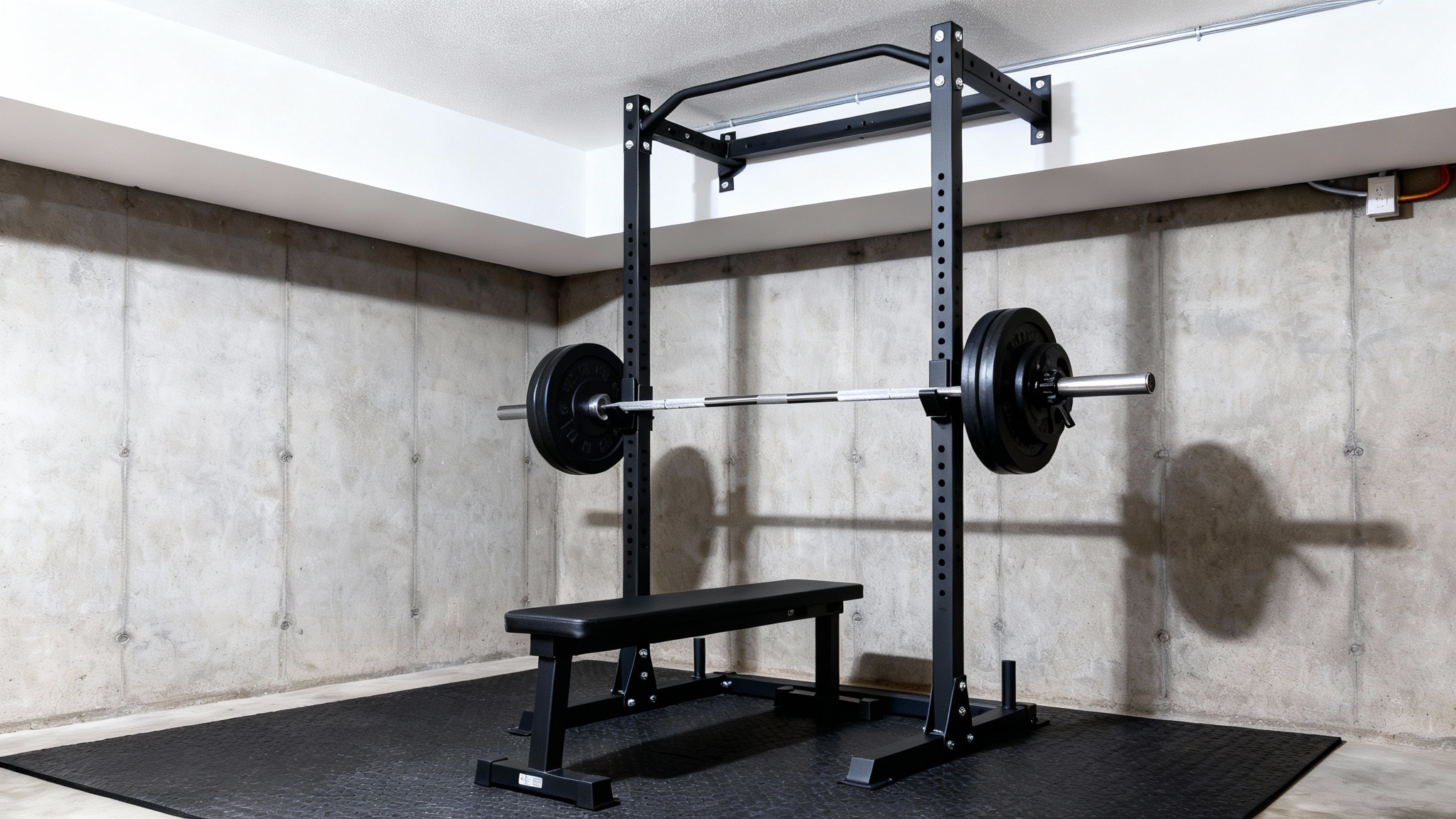
A rack under 80 in tall can reduce frame height without making the room suitable for every lift. Start with the complete assembled height of the exact configuration, then separately check installation, body movement, bar and plates.
A named short-stand example
Rogue’s SML-1 is marketed as a “70” stand but lists 72.25 in total height and a 49 × 48 in base. It has no pull-up-bar add-on. Under a hypothetical clear 80 in ceiling, the frame remainder is 80 − 72.25 = 7.75 in (19.685 cm). That arithmetic does not verify assembly room, attachment height or exercise clearance.
Do not assume every short stand accepts every safety arm or that a half rack can be mounted lower. Ask for the exact model, configuration and current drawing, including feet, crossmembers and attachments.
Check the three lifting paths
- Squat: check unracking, standing, walkout and return, including the highest plate and lowest obstruction throughout the path.
- Bench: check the correct bench position, user entry, unrack and compatible safety setup. A typical bench or bar height does not establish safe use under an 80 in ceiling.
- Press: establish the actual bar-center path and plate radius. Seated or inclined variations have their own movement envelopes and are not automatic solutions.
Use unloaded planning measurements where they can be obtained safely. Do not perform a loaded press to see whether it contacts the ceiling, and do not substitute a push press or pin press for unknown lockout room.
Pull-up-bar position is not adjustable by assumption
Only use a lower or inverted bar position if permitted for the exact product. Lowering a bar increases overhead room but decreases the floor gap in the same body position. Rings or a doorway bar still need their own permitted support and complete movement checks.
For comparison, Rogue’s RML-3W wall rack lists 90.375 in uprights. Its folding capability does not make it an under-80 in model or allow an improvised lower installation. Never cut uprights or move structural components based on a generic guide.
Installation and storage can need more height
Check whether the rack is assembled upright or tilted, and the path required for any removable top member. An installed frame that fits does not prove it can be assembled in that space. Map rails, beams, lights and other moving mechanisms rather than assigning them a universal small buffer.
Finish the floor plan too
Measure from the final supporting floor, account for planned thickness once, and confirm both bar-loading ends, bench movement and access. Check exact anchoring and compatible safeties; short height does not establish stability or building support. Keep an unresolved measurement marked unknown until the manufacturer or appropriate installer resolves it.
Continue planning
- Check independent pull-up floor and overhead margins
- Compare complete frame and exercise height
- Compare exact bar lengths, rack compatibility and both loading ends
Relevant Gear
FAQ
Does a “70” rack have a 70 in overall height?
Not necessarily. Rogue’s SML-1 lists 72.25 in total height. Use the complete named configuration rather than the model label.
Can I bench safely below 80 in?
Ceiling height alone cannot answer. Verify the complete bar/plate and user movement, bench position and compatible safety setup.
Can I mount a folding rack lower to fit?
Only use a configuration explicitly permitted for that exact product; folding does not authorize structural changes.