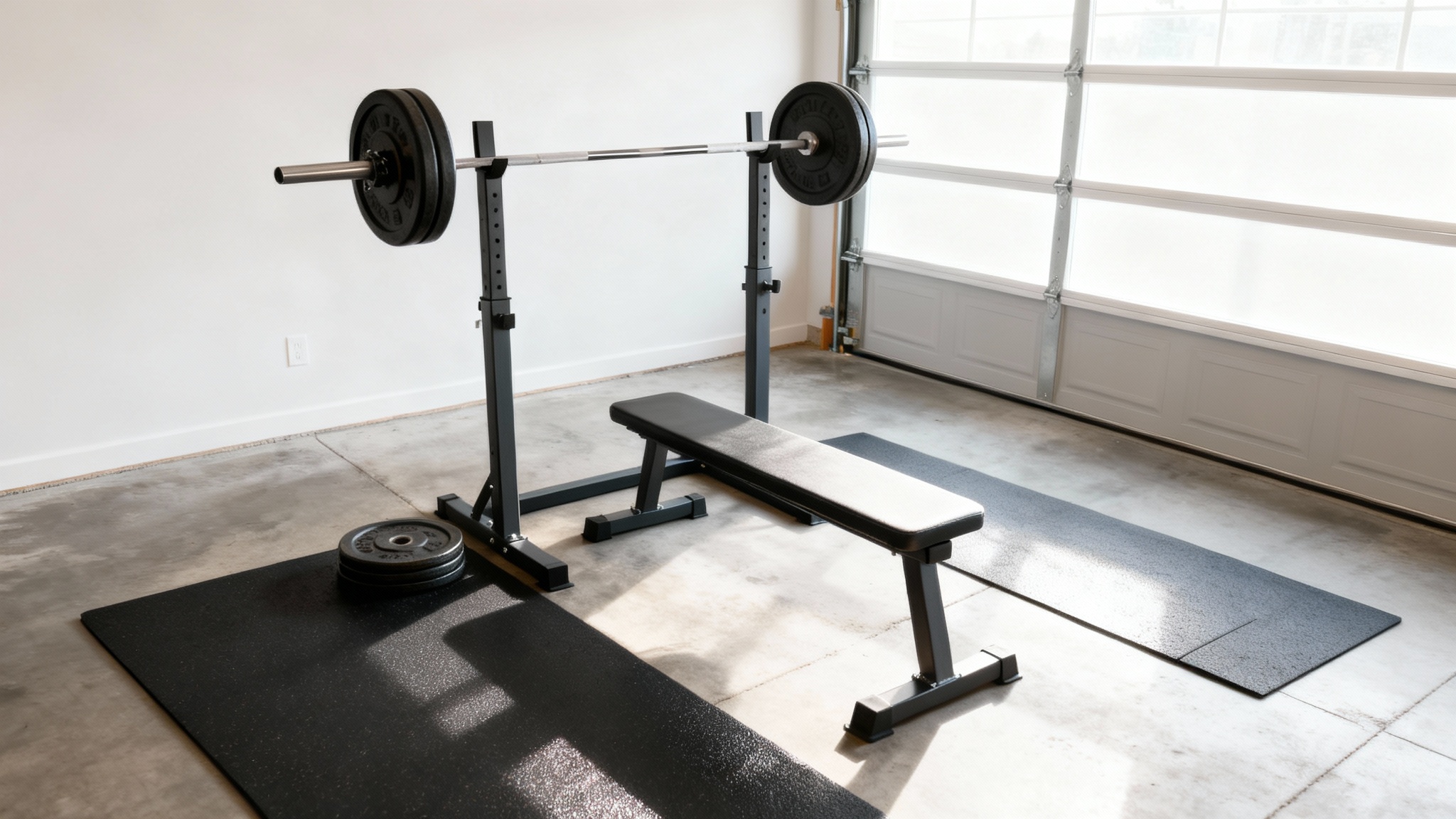
A $1,500 setup is a budget constraint to verify at checkout, not a promised package. Choose the intended training, compatible equipment and room first, then price every required component. No live seller quotes or product tests support the allocations below.
A complete hypothetical allocation
| Budget line | Chosen cap |
|---|---|
| Bar | $250 |
| Plates | $300 |
| Bench | $175 |
| Rack/stand plus required compatible safeties and mounting | $400 |
| Collars and floor protection | $125 |
| Delivery and tax reserve | $250 |
| Total | $1,500 |
The first five lines total $1,250, leaving $250 for the reserve. These allocations may be impossible for a particular equipment combination or delivery location. If real required costs exceed a cap, change scope or budget; do not omit safeties, anchors or collars to preserve the headline.
Replace every cap with an actual dated quote in the correct market and currency. If the subtotal exceeds $1,250 in this example, less than the planned $250 remains for delivery and tax. Check those charges before deciding whether the complete purchase meets $1,500.
Check one complete equipment combination
- Bar and rack: match support area, shaft spacing and allowed use. Rogue’s 72 in C-70S is marketed as rackable with 52 in between sleeves; the 69 in C-70 has 43 in and a stated conventional-rack limitation. Shorter does not necessarily mean compatible.
- Plates and collars: match the exact sleeve and sum plate thickness plus collar space. Plate mass alone does not determine sleeve fit.
- Bench: check base, pad, adjustment, intended use and the correct racked position.
- Rack and safeties: verify the complete intended configuration, load guidance and anchoring. Required safety components belong in the initial cost.
- Floor: select protection for the actual surface and equipment; bumper plates alone do not guarantee floor protection or neighbor-noise control.
Measure before buying the bargain
Use complete assembled dimensions, both bar-loading ends, bench/user movement and the lowest ceiling obstruction. The planner helps organize outlines; it does not verify an entire lift, installation, building load or product condition. A rack fitting a rectangle cannot establish that every item in a shopping list works together.
Used equipment still needs verification
A low price does not establish the condition of a used bench, rack, bar or plates. Confirm the exact model, all required parts, condition and any applicable recall/inspection information. Obtain appropriate help for uncertain structural or safety-critical damage. Include replacement parts and collection costs before comparing totals.
Keep the checkout worksheet
Record item, exact version, quantity, native-currency price, required accessories, delivery, tax and quote date. Do not treat an unknown charge as zero or mix currencies as dollars. Recheck the final total and compatibility before ordering; discounts and stock can change.
Continue planning
- Compare exact bar lengths, rack compatibility and both loading ends
- Measure the complete proposed room
- Separate flooring protection, structural capacity and neighbor noise
- Organize measured equipment outlines in the room planner
Relevant Gear
FAQ
Is this a confirmed setup under $1,500?
No. It is a hypothetical allocation. Verify actual compatible equipment, required safety parts, delivery and tax before treating the total as achievable.
Can I add safety arms later to stay within budget?
Do not omit components required for the intended use. Include the compatible safety and mounting configuration in the initial plan or change the scope.
Does a compact short bar fit any rack?
No. Compare actual shaft spacing, supports and manufacturer compatibility; the C-70S and C-70 examples have different rackability.