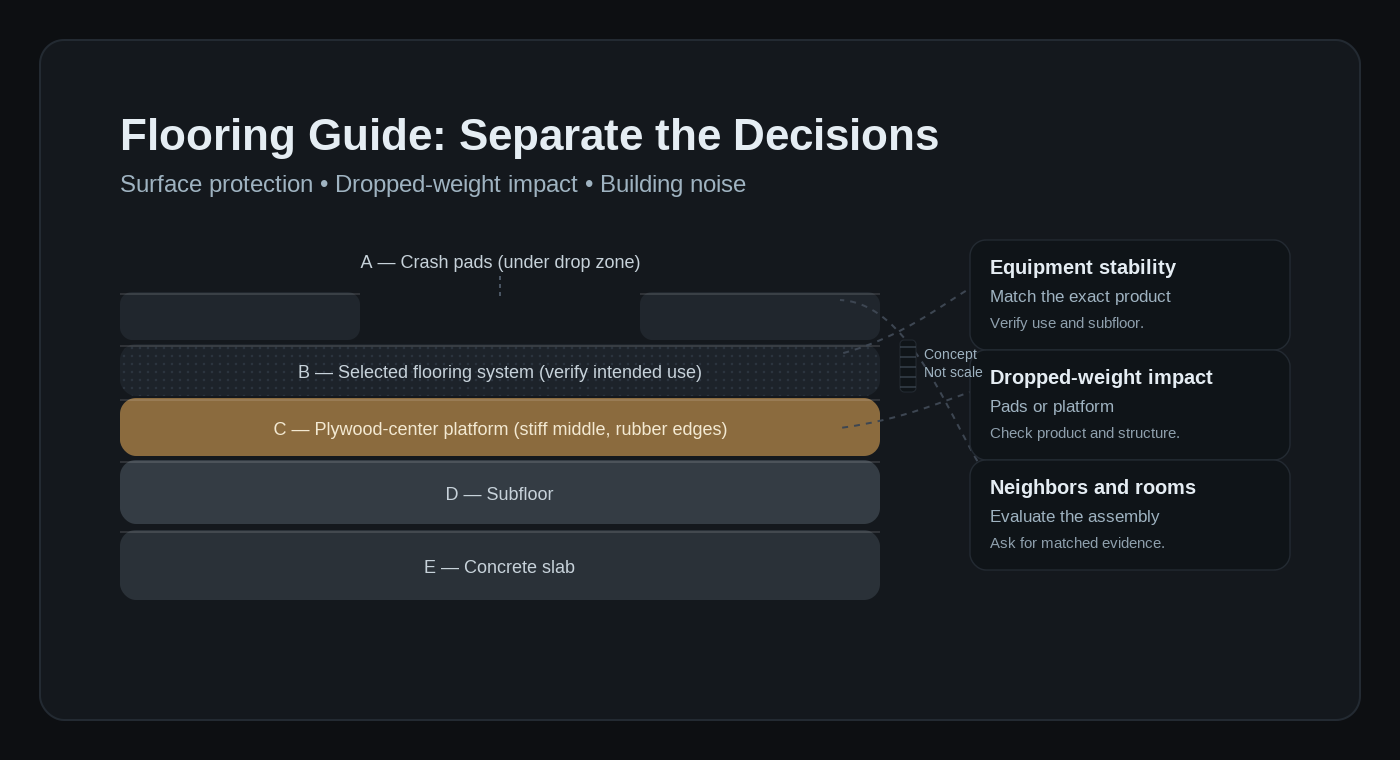
Home gym flooring has more than one job. Surface protection, equipment stability, dropped-weight impact and noise in another room are separate decisions. A rubber thickness by itself does not prove that a floor is protected, a lift is safe or a neighbor will not hear or feel the impact.
Choose for the actual floor and training
- Surface protection and stability: Check the flooring manufacturer's intended use, installation instructions and compatibility with your subfloor. Also confirm that racks, benches and cardio equipment sit level and do not move on the finished surface.
- Dropped weights: Use controlled lowering whenever the exercise allows it. A platform or purpose-built drop pad can manage impact at the drop point, but its product specification does not establish the capacity of the building below it.
- Neighbors and other rooms: Airborne sound and structure-borne vibration travel differently. Results depend on the complete floor and building assembly, not simply on choosing a thicker tile.
Why there is no universal noise thickness
Engineered acoustic systems are specified as complete assemblies. For example, REGUPOL describes sonusfit m520 as a 70 mm multi-layer system designed for low-frequency isolation and impact absorption in mixed-use buildings. That product-specific example does not show that an ordinary 8, 12 or 15 mm gym tile will provide the same result.
If noise or vibration could affect another home or business, get advice for the actual room, structure and intended drops. Ask for test evidence that matches the proposed assembly rather than relying on a tile thickness alone.
Platforms, pads and installation
- Platforms: Confirm the platform design, finished height, equipment footprint and doorway clearance. Plywood can spread load locally, but it is not proof of structural capacity or acoustic isolation.
- Drop pads: Rogue markets its Crash Cushion as a shock-absorbing, sound-dampening product for bar and plate drops. Treat that as a product claim for the pads—not a guarantee for every room, floor or neighbor.
- Tiles and rolls: Follow the product's seam, edge, adhesive, temperature and ventilation instructions. Use reducers or another specified transition where a raised edge could become a trip hazard.
- Quantity: Measure the covered area and use the flooring calculator for tile or pack counts. The calculator estimates quantity and cost; it does not certify suitability, sound isolation or structural capacity.
Before buying: write down the subfloor, equipment loads, whether weights will be dropped, the rooms below or beside the gym and the exact flooring or pad system. Those details are more useful than a universal thickness rule.
Sources and verification
Official product pages checked 24 October 2026. Product specifications and assemblies can change; confirm the current installation and technical documents before buying.
Plan how much flooring to order
Once you have chosen flooring suitable for your room and training, use your measured area and the tile's usable coverage to estimate whole tiles and packs.
Calculate flooring tiles, packs and estimated cost
Enter your own pack price; shipping, tax and installation are excluded. Quantity does not verify thickness, sound isolation or floor load capacity.
Relevant Gear
FAQ
What thickness is best for deadlifts?
There is no universal thickness for every deadlift setup. Match the exact flooring, platform or drop-pad specification to the subfloor, equipment, intended drops and building conditions. A thickness alone does not certify impact protection, structural capacity or neighbor noise.
Do rubber tiles smell?
Products vary. Check the manufacturer's ventilation, cleaning and installation instructions, and confirm that the material is suitable for the room before installation.
What flooring is best for apartments?
Apartment results depend on the complete floor and building assembly and on how you train. Ask for assembly-specific acoustic evidence and building approval where needed; ordinary tile thickness alone does not establish sound or vibration isolation.
Do I need a full platform?
It depends on the lift, equipment, subfloor and intended drops. A platform or purpose-built drop pad can manage local impact, but it does not by itself certify the building structure or noise performance.